Joint Statement on Lights & Siren Vehicle Operations on Emergency Medical Services (EMS) Responses
February 14, 2022
Douglas F. Kupas, Matt Zavadsky, Brooke Burton, Shawn Baird, Jeff J. Clawson, Chip Decker, Peter Dworsky, Bruce Evans, Dave Finger, Jeffrey M. Goodloe, Brian LaCroix, Gary G. Ludwig, Michael McEvoy, David K. Tan, Kyle L. Thornton, Kevin Smith, Bryan R. Wilson
Download PDF Position Statement
The National Association of EMS Physicians and the then National Association of State EMS Directors created a position statement on emergency medical vehicle use of lights and siren in 1994 (1). This document updates and replaces this previous statement and is now a joint position statement with the Academy of International Mobile Healthcare Integration, American Ambulance Association, American College of Emergency Physicians, Center for Patient Safety, International Academies of Emergency Dispatch, International Association of EMS Chiefs, International Association of Fire Chiefs, National Association of EMS Physicians, National Association of Emergency Medical Technicians, National Association of State EMS Officials, National EMS Management Association, National EMS Quality Alliance, National Volunteer Fire Council and Paramedic Chiefs of Canada.
In 2009, there were 1,579 ambulance crash injuries (2), and most EMS vehicle crashes occur when driving with lights and siren (L&S) (3). When compared with other similar-sized vehicles, ambulance crashes are more often at intersections, more often at traffic signals, and more often with multiple injuries, including 84% involving three or more people (4).
From 1996 to 2012, there were 137 civilian fatalities and 228 civilian injuries resulting from fire service vehicle incidents and 64 civilian fatalities and 217 civilian injuries resulting from ambulance incidents. According to the
U.S. Fire Administration (USFA), 179 firefighters died as the result of vehicle crashes from 2004 to 2013 (5). The National EMS Memorial Service reports that approximately 97 EMS practitioners were killed in ambulance collisions from 1993 to 2010 in the United States (6).
Traffic-related fatality rates for law enforcement officers, firefighters, and EMS practitioners are estimated to be 2.5 to 4.8 times higher than the national average among all occupations (7). In a recent survey of 675 EMS practitioners, 7.7% reported being involved in an EMS vehicle crash, with 100% of those occurring in clear weather and while using L&S. 80% reported a broadside strike as the type of MVC (8). Additionally, one survey found estimates of approximately four “wake effect” collisions (defined as collisions caused by, but not involving the L&S operating emergency vehicle) for every crash involving an emergency vehicle (9).
For EMS, the purpose of using L&S is to improve patient outcomes by decreasing the time to care at the scene or to arrival at a hospital for additional care, but only a small percentage of medical emergencies have better outcomes from L&S use. Over a dozen studies show that the average time saved with L&S response or transport ranges from 42 seconds to 3.8 minutes. Alternatively, L&S response increases the chance of an EMS vehicle crash by 50% and almost triples the chance of crash during patient transport (11). Emergency vehicle crashes cause delays to care and injuries to patients, EMS practitioners, and the public. These crashes also increase emergency vehicle resource use through the need for additional vehicle responses, have long-lasting effects on the reputation of an emergency organization, and increases stress and anxiety among emergency services personnel.
Despite these alarming statistics, L&S continue to be used in 74% of EMS responses, and 21.6% of EMS transports, with a wide variation in L&S use among agencies and among census districts in the United States (10).
Although L&S response is currently common to medical calls, few (6.9%) of these result in a potentially lifesaving intervention by emergency practitioners (12). Some agencies have used an evidence-based or quality improvement approach to reduce their use of L&S during responses to medical calls to 20-33%, without any discernable harmful effect on patient outcome. Additionally, many EMS agencies transport very few patients to the hospital with L&S.
Emergency medical dispatch (EMD) protocols have been proven to safely and effectively categorize requests for medical response by types of call and level of medical acuity and urgency. Emergency response agencies have successfully used these EMD categorizations to prioritize the calls that justify a L&S response. Physician medical oversight, formal quality improvement programs, and collaboration with responding emergency services agencies to understand outcomes is essential to effective, safe, consistent, and high-quality EMD.
The sponsoring organizations of this statement believe that the following principles should guide L&S use during emergency vehicle response to medical calls and initiatives to safely decrease the use of L&S when appropriate:
- The primary mission of the EMS system is to provide out-of-hospital health care, saving lives and improving patient outcomes, when possible, while promoting safety and health in communities. In selected time-sensitive medical conditions, the difference in response time with L&S may improve the patient’s
- EMS vehicle operations using L&S pose a significant risk to both EMS practitioners and the public. Therefore, during response to emergencies or transport of patients by EMS, L&S should only be used for situations where the time saved by L&S operations is anticipated to be clinically important to a patient’s outcome. They should not be used when returning to station or posting on stand-by
- Communication centers should use EMD programs developed, maintained, and approved by national standard-setting organizations with structured call triage and call categorization to identify subsets of calls based upon response resources needed and medical urgency of the call. Active physician medical oversight is critical in developing response configurations and modes for these EMD protocols. These programs should be closely monitored by a formal quality assurance (QA) program for accurate use and response outcomes, with such QA programs being in collaboration with the EMS agency physician medical
- Responding emergency agencies should use response based EMD categories and other local policies to further identify and operationalize the situations where L&S response or transport are clinically Response agencies should use these dispatch categories to prioritize expected L&S response modes. The EMS agency physician medical director and QA programs must be engaged in developing these agency operational policies/guidelines.
- Emergency response agency leaderships, including physician medical oversight and QA personnel should monitor the rates of use, appropriateness, EMD protocol compliance, and medical outcomes related to L&S use during response and patient
- Emergency response assignments based upon approved protocols should be developed at the local/department/agency level. A thorough community risk assessment, including risk reduction analysis, should be conducted, and used in conjunction with local physician medical oversight to develop and establish safe response
- All emergency vehicle operators should successfully complete a robust initial emergency vehicle driver training program, and all operators should have required regular continuing education on emergency vehicle driving and appropriate L&S
- Municipal government leaders should be aware of the increased risk of crashes associated with L&S response to the public, emergency responders, and patients. Service agreements with emergency medical response agencies can mitigate this risk by using tiered response time expectations based upon EMD categorization of calls. Quality care metrics, rather than time metrics, should drive these contract
- Emergency vehicle crashes and near misses should trigger clinical and operational QA reviews. States and provinces should monitor and report on emergency medical vehicle crashes for better understanding of the use and risks of these warning devices.
- EMS and fire agency leaders should work to understand public perceptions and expectations regarding L&S use. These leaders should work toward improving public education about the risks of L&S use to create safer expectations of the public and government
In most settings, L&S response or transport saves less than a few minutes during an emergency medical response, and there are few time-sensitive medical emergencies where an immediate intervention or treatment in those minutes is lifesaving. These time-sensitive emergencies can usually be identified through utilization of high-quality dispatcher call prioritization using approved EMD protocols. For many medical calls, a prompt response by EMS practitioners without L&S provides high-quality patient care without the risk of L&S-related crashes. EMS care is part of the much broader spectrum of acute health care, and efficiencies in the emergency department, operative, and hospital phases of care can compensate for any minutes lost with non-L&S response or transport.
Sponsoring Organizations and Representatives:
Academy of International Mobile Healthcare Integration
American Ambulance Association
American College of Emergency Physicians
Center for Patient Safety
International Academies of Emergency Dispatch
International Association of EMS Chiefs
International Association of Fire Chiefs
National Association of EMS Physicians
National Association of Emergency Medical Technicians
National Association of State EMS Officials
National EMS Management Association
National EMS Quality Alliance
National Volunteer Fire Council
References:
- Use of warning lights and siren in emergency medical vehicle response and patient transport. Prehosp and Disaster Med. 1994;9(2):133-136.
- Grant CC, Merrifield Analysis of ambulance crash data. The Fire Protection Research Foundation. 2011. Quincy, MA.
- Kahn CA, Pirallo RG, Kuhn EM. Characteristics of fatal ambulance crashes in the United States: an 11-year retrospective Prehosp Emerg Care. 2001;5(3):261-269.
- Ray AF, Kupas DF. Comparison of crashes involving ambulances with those of similar-sized vehicles. Prehosp Emerg Care. 2005;9(4):412-415.
- S. Fire Administration. Firefighter fatalities in the United States in 2013. 2014. Emmitsburg, MD.
- Maguire Transportation-related injuries and fatalities among emergency medical technicians and paramedics.
Prehosp Disaster Med. 2011;26(5): 346-352.
- Maguire BJ, Hunting KL, Smith GS, Levick Occupational fatalities in emergency medical services: A hidden crisis.
Ann Emerg Med, 2002;40: 625-632.
- Drucker C, Gerberich SG, Manser MP, Alexander BH, Church TR, Ryan AD, Becic Factors associated with civilian drivers involved in crashes with emergency vehicles. Accident Analysis & Prevention. 2013; 55:116-23.
- Clawson JJ, Martin RL, Cady GA, Maio RF. The wake effect: emergency vehicle-related collisions. Prehosp Disaster Med. 1997; 12 (4):274-277.
- Kupas DF. Lights and siren use by emergency medical services: Above all, do no harm. National Highway Traffic Safety Administration. 2017. Available online at https://www.ems.gov/pdf/Lights_and_Sirens_Use_by_EMS_May_2017.pdf
- Watanabe BL, Patterson GS, Kempema JM, Magailanes O, Brown LH. Is use of warning lights and sirens associated with increased risk of ambulance crashes? A contemporary analysis using national EMS information system (NEMSIS) Ann Emerg Med. 2019;74(1):101-109.
- Jarvis JL, Hamilton V, Taigman M, Brown LH. Using red lights and sirens for emergency ambulance response: How often are potentially life-saving interventions performed? Prehosp Emerg Care. 2021; 25(4): 549-555.
-555


_2106244.jpg)






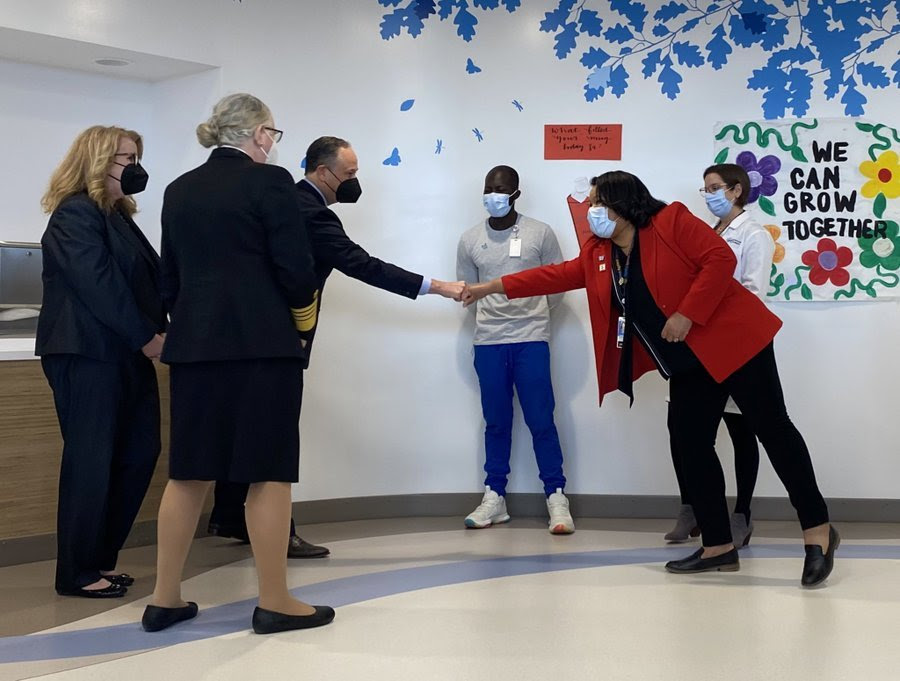 In his State of the Union address, President Biden announced an ambitious strategy to address our national mental health crisis. At the Health Resources and Services Administration, we stand with the President in his call for unity in our national response and know that for the millions of Americans living with a mental health condition or caring for a loved one with a mental health condition, the time for action is now.
 In February, HRSA announced the winners of the Promoting Pediatric Primary Prevention Challenge, $66.5 million to support community-based vaccine outreach efforts, more than $560 million in pandemic relief payments to health care providers, funding to increase virtual care quality and access, and new funding to support primary care residency programs.
 With this funding, nearly $19 billion will have been distributed from the Provider Relief Fund and the American Rescue Plan Rural provider funding since November 2021
 Our
Our  A
A  Climate change influences human health and diseases in numerous ways. Underserved communities stand to bear the brunt of these climate-induced risks (e.g., extreme heat, poor air quality, flooding, extreme weather events). HRSA and CDC’s Climate and Health Program invite you to consider the impacts of climate change on the U.S. health care system. CDC will share its work to build resilience to these public health effects.
 Patient Safety Awareness Week is March 13-19. We are hosting an event in partnership with the Agency for Healthcare Research and Quality (AHRQ), the Centers for Disease Control and Prevention (CDC), the Centers for Medicare & Medicaid Services (CMS), the Food and Drug Administration (FDA), the Indian Health Service (IHS), and the National Institutes of Health (NIH).
 Children’s mental health continues to be a top priority for state leaders across both legislative and executive branches of state government. With COVID-19 exacerbating the challenges children are facing, there is much more work to be done.








-1.png?w=600&format=jpg&quality=87&crop=46%2C0%2C300%2C169)


